 Idiomatic Bytes
The age of personal software
You can generate the software you want for yourself on demand. From an idea to a working loyalty card app on the drive to Lidl.
Listen5:44We live in the future.
It’s easy to get used to what each new model can do, and it doesn’t take long. But I’m still speechless about what happened the Saturday after Opus 5.5 came out.
Here’s the story.
I used to use an app called Stocard for loyalty cards, and it was epic. It was perfect. It was simple: you scanned the card and it was stored locally. I think it even had cool features where, if you turned them on, it could notify you when you were in the shop. I don’t even really care about that. It was just reliable. It opened. I didn’t have to sign in or do anything. It stored the card. It just functioned perfectly.
Then it got acquired by Klarna, who are trying to build some kind of everything-money app. They rebranded it, and the first time I opened it after they’d changed it, I had to sign up and create an account. I was literally trying to buy something, trying to scan my loyalty card, and that was my first experience. I haven’t had many better experiences with it since. They completely destroyed the app. It’s inside their everything-money app now and it’s just terrible.
So I was like, that’s so annoying. Maybe I should go and look for another one.
But you know what? No. Opus 5.5 is out. I’m going to prompt one into existence.
And I did.
First, I had a chat with Grok. I got it to do some research for me, and we went back and forth on what the app should do. I had the idea in the morning, talking through it with Grok, while the kids were at the playground (don’t judge me!).
Then I sent the prompt to Opus. I have a Mac mini at home, and you can run
claude rc to start a remote control session. Actually, I didn’t do that. I
told my OpenClaw to do it for me. That’s another story.
Remote control session started, I pasted in the prompt Grok had made for me after we’d gone through all our decisions. It was basically: build a loyalty card wallet app. The name is Lodgey. The mascot and icon should be like so. These are the features it needs. It just needs to be able to add, edit and delete cards. It should have a really nice UI, with 3D motion, buttery-smooth animations, sound effects, and delight. There were a few more details, but that was the gist.
One of my boys was down for a nap, and me and the other guy were heading to Lidl to do the grocery shopping. So before we left, I set up the Claude session, sent the prompt, and it started working.
By the time I got to Lidl and parked, it had created the first version of the app, which in itself was impressive. But it had also launched the app on my Tailscale network and sent me the URL.
I opened it and added my own Lidl card. Actually, I couldn’t scan it. I hadn’t asked for the scan feature yet, just the version where you type in the number. So I sent OpenClaw a screenshot of my Lidl card, it extracted the number for me, I pasted it into the app, and I had my Lidl card.
Then I scanned my Lidl card at the till. It worked.

So basically: I had no app, just an idea, as I left for Lidl. By the time I arrived at Lidl, I had a functional web app. It’s a Flutter app, and it’s going to be a mobile app, but the web version was the quickest way. I can’t set up TestFlight and App Store Connect and all that in the time it takes to get to Lidl.
I can’t remember exactly, but Opus 5.5 worked on it for somewhere between 10 and 15 minutes.
If that was the whole story, the utility alone would be outrageous. We are in the age of personal software. You can generate the software you want for yourself on demand, almost in real time. Sure, you can share it with other people. But even if I never do, I like it, and it cost me next to nothing.
Now, the app. The app is exquisite.
It’s simple. There are no users and no auth. There’s just a database, and the database stores the details of each card. A card can have a name and an icon, and then it has a number. Barcodes come in a few different formats, and it supports the most common ones.
It kind of looks like Apple Wallet. You open it up and you have a list of cards, but they’re not all perfectly straight. There’s a bit of character to it. The colours are nice. The app icon is tasteful. And there are the animations and the sound effects.
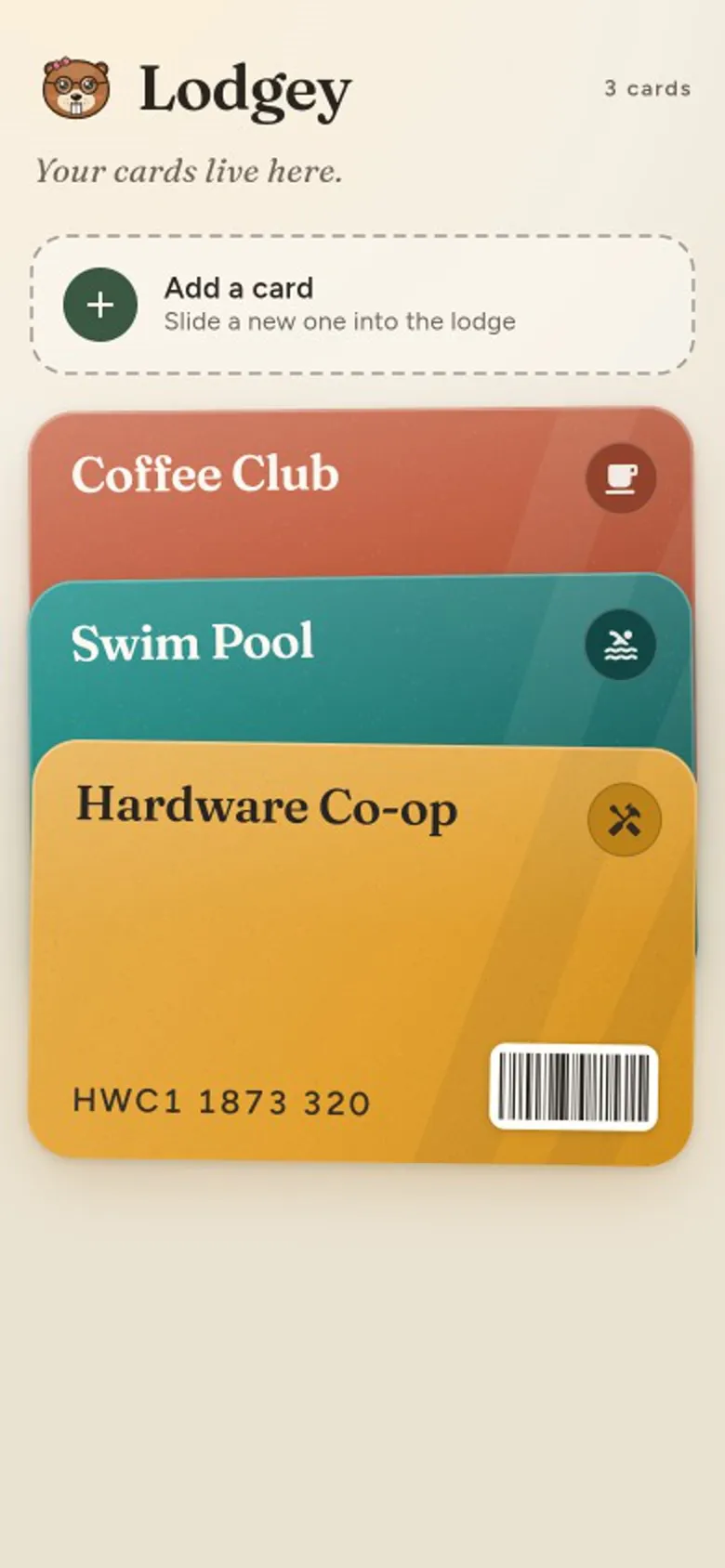
It has an unbelievable level of polish, considering how long it would take me to actually build it. I’m not saying it’s a very hard app. But what it built was a one-shot, and the level of detail and polish is something else: the 3D motion, the sound effects, the animation.
There’s a hero animation. You have the stack of cards, and whichever card you tap animates out of the stack. It stays behind the card in front of it and above the one below it, and when it animates back from the detail page, it slots back in between them.
It’s not rocket science. But that’s a very polished detail to get from a one-shot prompt, with no design.
So yeah, I think it’s time to start dreaming bigger about what to build. I’ve got some ideas. Do you?
PS – Check out Lodgey’s landing page for early access: lodgey.app